Foreign retirees vs locals in the Dominican Republic
26 de octubre de 2026 · 5 min min read
Two distinct retirement worlds in the DR: expatriates in gated communities vs local retirees in traditional neighborhoods. Understand the differences.
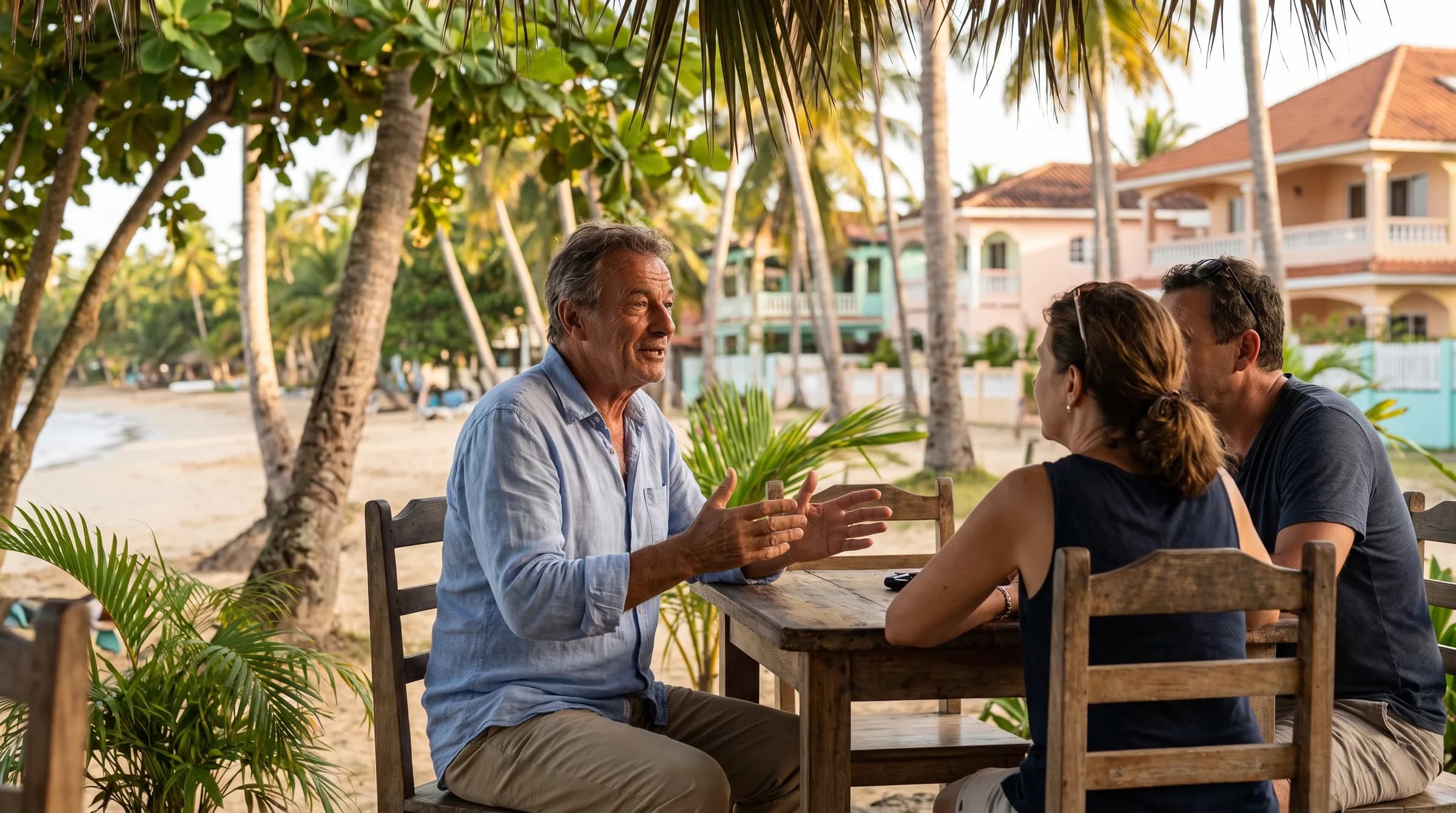
Two retirement worlds: foreign retirees vs locals in the Dominican Republic
When Miguel, 58, visited Las Terrenas for the first time, he was surprised to hear more French and English than Spanish in the downtown cafés. He'd arrived looking for property information for his retirement, but found something unexpected: two completely different ecosystems of retirees living in parallel in the same city.
This division between foreign retirees vs locals in the Dominican Republic isn't just a social curiosity. It's a reality that defines where you live, how you connect with others, and what kind of life you build during retirement. Understanding these differences before you start searching for property can save you from surprises and help you choose the environment that truly fits your expectations.
The geography of expatriate communities
In the Dominican Republic, foreign retirees concentrate mainly on the north coast: Las Terrenas, Sosúa, Cabarete, and Puerto Plata are home to thousands of European, American, and Canadian residents. These communities didn't emerge by accident.
Toca Timbre
Verified properties, certified agents. You just decide.
Expatriates prioritize specific factors: gated developments with 24/7 security, landscaping administration, neighborhoods where their language is spoken, and access to private healthcare. An apartment in a gated community in Sosúa might cost between US$150,000 and US$300,000, but it includes a pool, common areas, and most importantly, other foreign retirees as neighbors.
Their social life revolves around organized activities: English-language walking groups, wine gatherings, charity events, and beach sports coordinated through expatriate social networks. You'll commonly find bulletin boards in supermarkets with postings exclusively in English or French.
Traditional Dominican retirement
 Local retirees, in contrast, build their retirement in traditional neighborhoods of Santo Domingo, Santiago, Puerto Plata, or mountain towns like Jarabacoa. Their support networks are based on extended family, church, community associations, and spaces like small grocery stores, parks, and social clubs.
A typical retirement home for a Dominican retiree might cost between RD$3,000,000 and RD$8,000,000 (roughly US$50,000 to US$135,000), but the purchase decision focuses on proximity to family, everyday services, and the neighborhood life they already know.
Their social environments are less structured by real estate developments and more shaped by cultural dynamics: family gatherings, religious celebrations, street dominoes, and participation in community life. They navigate the national public and private healthcare systems with greater familiarity.
The misconception about integration
Many expatriates arrive in the Dominican Republic believing they'll automatically integrate into local culture, regardless of where they buy. The reality is different.
Living in a gated community oriented exclusively to the international market can create a "bubble" where it's possible to spend months without meaningful interaction with Dominicans. On the other hand, some foreign retirees who choose traditional neighborhoods feel isolated by language barriers and cultural differences.
The impact on property searches
This social divide directly reflects how each group searches for and buys homes. Foreign retirees typically work with agents who understand concepts like CONFOTUR (tourism incentive regime), prices in dollars, and specialized services for international buyers.
Local retirees, meanwhile, acquire properties through informal brokers, personal contacts, or local agents, prioritizing family referrals over formal verification.
Here's where a problem emerges: in the Dominican Republic there's no mandatory license requirement to work as a real estate agent, which makes verification crucial, especially for foreign buyers unfamiliar with the local market.
The importance of transparency in the process
Verification of real estate agents becomes essential when you want to truly understand what kind of community you're choosing. Associations like AEI (Association of Real Estate Agents and Companies) publish directories of member agents that can be consulted publicly.
A verified agent can clearly explain whether you're entering:
- A planned community almost exclusively for foreigners
- A traditional Dominican neighborhood
- A middle ground where both groups coexist
This information doesn't just reduce legal risks—it helps you align the social environment you choose with your actual retirement motivations.
Deciding your community type consciously
There's no right or wrong choice, but there is the option to decide consciously. Some foreign retirees thrive in expatriate communities where they can maintain their cultural traditions and speak their native language. Others prefer full cultural immersion in traditional Dominican neighborhoods. Many seek a balance.
What matters is that this decision is informed, not accidental. When you search for property without understanding these social dynamics, you can end up in an environment that doesn't match your expectations for integration, social activity, or lifestyle.
Your starting point determines your results
Where you begin gathering information about retirement in the Dominican Republic determines what options you'll know about. If you rely solely on specific project promoters or informal recommendations, your perspective narrows to just one type of community.
A transparent process, based on agents with verifiable references and clear conversations about the social profile of each area, lets you consciously compare living surrounded by expatriates, integrating into local communities, or finding spaces where both worlds naturally coexist.
If you're exploring retirement options in the Dominican Republic, Toca Timbre lets you connect directly with verified agents who can explain the real differences between expatriate communities and local neighborhoods. The app brings together properties from different real estate agents, allowing you to contact them via WhatsApp for clear information about the social environment of each area before making decisions. You can explore these options at Toca Timbre.
Frequently asked questions
Is it better to live in an expatriate community or a local neighborhood during retirement?
There's no single answer. Expatriate communities offer cultural familiarity, a common language, and services designed for foreigners, but they can limit immersion in Dominican culture. Local neighborhoods provide cultural authenticity and lower costs, but require greater adaptation to language and local customs. Your decision depends on your personal priorities for integration, language, and lifestyle.
How much more expensive is living in a gated community for foreigners compared to a traditional neighborhood?
Properties in gated communities oriented toward expatriates typically cost 50% to 100% more than similar properties in traditional neighborhoods. While a house in a foreign community might cost US$200,000-300,000, a comparable property in a local neighborhood might run US$80,000-150,000. However, gated communities include services like security, maintenance, and common areas that can justify the price difference.
How can I tell if a neighborhood has good integration between expatriates and locals?
Look for signs like businesses serving both foreigners and Dominicans, mixed community events, and naturally bilingual services (not forced). A verified agent can take you to visit different neighborhoods at different times to observe real dynamics. You can also ask in local social media groups or visit community centers to understand how both communities interact.