Investing in Real Estate in La Vega: A Buyer's Guide
27 de noviembre de 2026 · 6 min min read
A guide to understanding real estate in La Vega: how to compare listings, verify who is selling, and what to check before sending money, even from abroad.
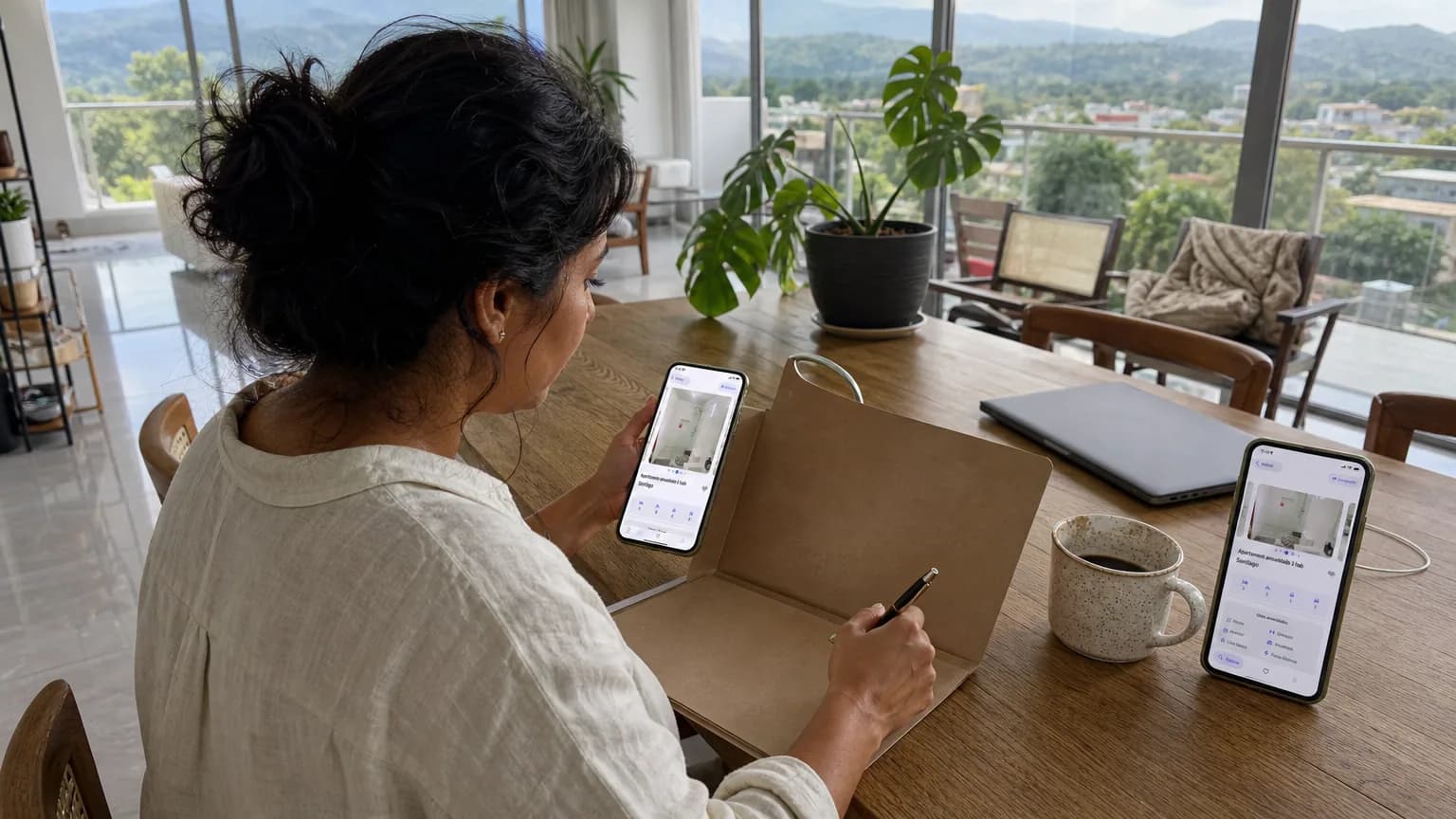
Talking about real estate in La Vega usually starts with a number: a price, a square footage, a photo. For someone searching from Santo Domingo, Santiago, or another country, that number arrives by WhatsApp, Instagram, or a listing portal, almost always without context.
This guide does not aim to tell you whether to buy or what to buy. It seeks to organize what is worth understanding first: what can be verified from a distance, what cannot, and in what order. If the process feels confusing, that is not a flaw on your part. It is the result of a market where information is scattered across many places.
Real estate in La Vega: what to look at before thinking about investing
La Vega offers a wide selection with very variable prices. One portal reported an approximate median of US$163,399 for properties listed in the area. Another platform shows, for apartments, median values near RD$7,890,000 and RD$61,400 per square meter. The figures differ because the methodology, the type of property, and the province or city being measured all change.
Toca Timbre
Verified properties, certified agents. You just decide.
These figures serve as a reference, not as an appraisal. A price can only be judged by comparing it with similar properties: same sector, similar square meters, age, condition, parking, and, above all, the status of the title. A finished home is not the same as a project still on blueprints or a plot of land.
If you are still comparing cities before deciding, the analysis of Santiago, Punta Cana and La Vega provides context on risk, return, and type of tenant.
The mistaken belief: "if the listing is clear, the property is trustworthy"
 Many buyers assume that good photos, a quick reply, and a convincing audio message mean everything is in order. This is understandable, because it creates a sense of seriousness. But a smooth conversation is not a verification.
A portal, a franchise, or a social media profile does not by itself prove that the person posting is the owner, a legitimate representative, or a trustworthy agent. And the law does not automatically check on the buyer's behalf who the holder is or whether the property is free of encumbrances. That review has to be done, and it should be done before committing money.
A real moment: the same apartment, five listings
Imagine a buyer we will call Carolina (illustrative example). She lives in Santo Domingo, has family in La Vega, and finds an apartment that interests her. Searching further, she sees it advertised like this:
- "RD$8.5 million, 120 m²"
- "RD$7.9 million, 100 m²"
- "US$150,000, 3 bedrooms"
- "Furnished apartment of 150 m²"
- A Reel with photos mentioning 228 m²
She feels a familiar knot: what is the real figure, is it the same apartment, does she have to choose the cheapest one? The calm answer is that she does not have to choose any of them yet. The differences may come from built area versus total area, from common areas, from a model unit, or from a simple error. They can also be a warning sign. What should not be done is accept the inconsistency without an explanation. There is more detail on this phenomenon in how to identify duplicate listings in the Dominican Republic.
The process, in order
The central idea is to separate two stages. The initial evaluation can be partly done remotely. The legal, technical, and financial due diligence should be left to independent professionals.
- Know who you are talking to. Ask for the full legal name, cédula or professional document, company, physical address, and authorization to market the property.
- Confirm the location. "La Vega" does not identify a building. Ask for an address or coordinates and compare them with the map and satellite images.
- Build a single fact sheet. Gather the price, currency, defined area (private, built, or total), bedrooms, bathrooms, parking, location, seller, and date of last update. If the listing does not answer, ask.
- Request documents. A copy of the title certificate, registration, cadastral designation, registered area, and the owner's identification. If an agent or attorney-in-fact is involved, also the document proving their authority to act.
- Request the Certificate of Legal Status of the Property. It certifies the legal status of the property and the validity of the duplicate title. It is a snapshot as of its issue date, so it must be current. The holder named must be the person selling.
- Retain an independent lawyer. This should not be the intermediary pressing for payment, nor someone recommended only by the seller. They can interpret mortgages, liens, boundary surveys, maintenance debts, and taxes.
To organize the stages before visits, the checklist for buying an apartment in the DR can serve as support.
Buying from abroad without sending money blindly
Distance does not eliminate verification; it changes who performs it. From abroad you can certainly ask for current photos and videos of the facade, interiors, meters, parking, and neighboring streets, or a live video call from the property. That helps, but it does not confirm ownership or structural quality.
There are basic precautions. Avoid sending a deposit, down payment, or "separation" fee to a personal account without a written contract. That contract should identify the property, the price, the currency, the payment method, the timeline, the outstanding documents, the refund conditions, and who holds the funds. It is reasonable for the reservation to depend on the legal and technical review coming back satisfactory.
If you cannot travel, there is the limited special power of attorney, which allows a lawyer or identified representative to sign specific acts. It is normally granted before a notary and, if signed outside the country, it is legalized or apostilled as applicable. It must describe the property, the transaction, and the powers granted with precision. A general or open-ended power increases the risk and should not be handed over without independent legal advice.
The anxiety of sending money from far away is normal. To give those transfers some structure, you can review how to structure remittances in three phases for real estate in the DR.
A closing reflection
Listings are useful for discovering a property. The decision rests on something else: a visit, written information, and an independent registry verification. Understanding real estate in La Vega does not require knowing everything, only knowing the order in which things should be checked. When the order is clear, the rush dies down, and so does the noise.
If something does not add up and nobody explains it, that is not bad luck on the buyer's part. It is information that is still missing.
If you want to explore the market more clearly, Toca Timbre is an app where buyers can see properties listed by agents and contact them directly through WhatsApp. You can learn more here: Toca Timbre. It is simply a starting point for looking calmly, with no commitment.
Frequently asked questions
Is it a good idea to invest in La Vega?
There is no single answer, because it depends on your goal, your budget, and your tolerance for risk. What you can do is compare in an orderly way: prices by sector, type of property, condition, and status of the title.
This article is not personalized financial advice. For a specific decision, it is advisable to rely on an independent lawyer and, if needed, an independent technical professional.
Can I buy a property in La Vega from abroad?
It is possible without traveling right away, as long as verification is in the hands of independent professionals. You can carry out part of the initial evaluation remotely: location, photos, live video, and price comparison.
Reviewing the title, encumbrances, and the seller's identity cannot be resolved with an audio message. If you need someone to sign on your behalf, the prudent option is a limited special power of attorney, with your own legal advice.
How do I know if the seller is the real owner?
Request a current Certificate of Legal Status of the Property and a copy of the title certificate. Compare the name of the holder with the identification of the person selling. If an agent or attorney-in-fact is acting, ask for the document proving their representation.
An independent lawyer can interpret mortgages, liens, or litigation. If the advertiser avoids sharing documents or pressures you to transfer money, it is reasonable to stop the process.
Sources
On Toca Timbre
- Santiago vs Punta Cana vs La Vega: Where to Invest in 2025?
- Duplicate Listings in the Dominican Republic: How to Identify Them
- Checklist for Buying an Apartment in the DR: Where to Start
- How to Structure Remittances in 3 Phases for Real Estate in the DR
External references