How to Save for a Down Payment on a Home in the Dominican Republic
21 de septiembre de 2026 · 5 min min read
Discover why unstructured saving creates anxiety and how to build a clear plan with realistic goals for your first home in the DR.
How to Save for a Down Payment on a Home in the Dominican Republic
Most Dominicans dreaming of their first apartment make the same mistake: start saving money without a clear target. "I'll save what I can and we'll see what happens" is the phrase that sums up this intuitive approach, but it ends up generating more frustration than results. Saving for a down payment on a home in the Dominican Republic requires first knowing the real numbers in the market, not just good intentions.
This problem goes beyond financial discipline. When you don't know exactly how much you need, every peso you set aside feels insufficient. Anxiety grows because there's no visible finish line, only the constant feeling that "I need more," but without knowing how much "more" actually is.
The Most Common Mistake: Saving Without Knowing the Real Numbers
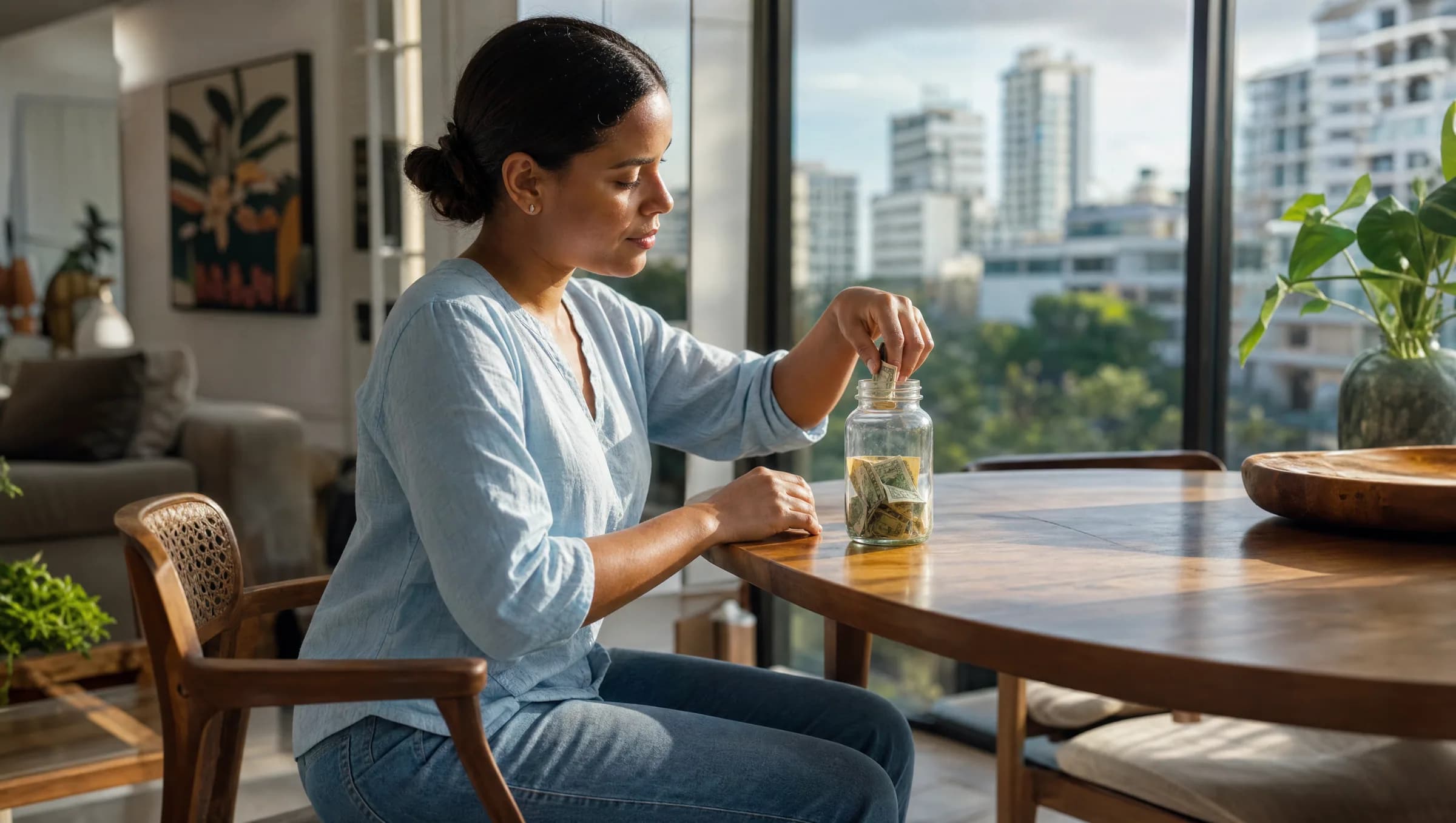
Carla has been putting money in her regular savings account for two years, mixed together with her emergency fund and everyday expenses. Every month she contributes what she can, but has no idea how much she actually needs. She heard that "you have to save a lot for the down payment," but never looked up the specific numbers for the Dominican market.
Toca Timbre
Propiedades reales. Agentes verificados. Tú decides sin miedo.
The reality is that in the Dominican Republic, banks typically finance between 70% and 80% of the property value. This means you need to prepare between 20% and 30% as a down payment, plus closing costs that include transfer tax, legal fees, and appraisal—adding approximately 3% to 5% more of the total price.
For an apartment worth RD$5 million—a common price in areas like La Esperilla or Piantini—the down payment would be around RD$1 million to RD$1.5 million, plus about RD$200,000 in closing costs. Without this information, Carla was saving blind, with no way to know if her current RD$300,000 brought her to 20% of her real goal or just 5%.
Why Lack of Structure Creates Financial Anxiety
 When you mix money for housing with other savings, three things happen inevitably:
Impulse withdrawals: Since it's not separated, it's easy to "borrow" from that fund for other expenses and promise yourself you'll pay it back later.
Invisible progress: Without a clear numerical target, you can't celebrate milestones or adjust your plan when needed.
Paralysis from overwhelm: The final number seems so large and abstract that it feels impossible to reach, creating the temptation to put it off indefinitely.
In the Dominican context, this confusion is greater because down payment percentages vary by property type. In pre-construction projects, many developers allow you to pay the down payment in stages: 10% when you sign the contract, another 10% six months later, completing the 20% before delivery. For ready-made properties, some banks ask for up to 30% down, especially if it's your first mortgage.
How to Create a Structured Savings Plan
The alternative is to transform saving into an organized project with specific steps:
1. Define your realistic price range
Calculate how much you can pay monthly without exceeding 28-30% of your income. If you earn RD$80,000 monthly, your mortgage payment shouldn't exceed RD$24,000. At current rates, this allows you to finance roughly between RD$3.5 and RD$4.5 million.
2. Research specific requirements
Contact 2-3 banks to learn their actual conditions: down payment percentage, interest rates, maximum term, and income requirements. Each institution has different criteria, and this information defines your savings target.
3. Calculate your total goal
Not just the down payment, but also:
- Transfer tax (3% of property value)
- Legal fees (approximately RD$150,000-300,000)
- Bank appraisal (RD$15,000-25,000)
- Post-purchase reserve fund (3-6 months of payments)
4. Open a separate account and automate
Designate a specific account just for housing. Set up an automatic transfer every two weeks, treating it like a fixed bill, not something optional that happens "if there's leftover money."
The Turning Point: From Saving to Searching
When Carla reached 70% of her down payment goal, her mindset changed completely. She no longer felt like "the girl who saves hoping to buy someday," but a real buyer exploring concrete options within her price range.
This psychological shift is crucial. With a clear goal and visible progress, the process stops generating anxiety and starts creating positive excitement. Plus, when you know exactly what you have and what you need, you can enter the real estate market with realistic expectations, without wasting time looking at properties beyond your reach.
The Importance of Connecting with the Organized Market
Having the money is just the first step. The second is connecting with verified agents who manage properties with clear documentation and transparent pricing. Many buyers, after years of disciplined saving, end up wasting time with informal sellers or properties with legal issues.
Once your savings have structure, your search should too. This means platforms where you can filter by real price, specific location, and connect directly with professionals who understand the complete buying process.
Reflection: Savings as Foundation, Not Final Goal
The real shift happens when you understand that saving for a down payment isn't the end of the road, but the entry point to a larger process. With clarity on the real amounts and an automated savings structure, you reduce financial anxiety and prepare yourself to make real estate decisions from a solid position.
The Dominican real estate market can seem chaotic, but when your financial preparation is organized, you navigate with more confidence. The difference isn't in how much you save, but in how you do it: with clear goals, defined timelines, and real knowledge of what you need.
If you already have clarity on your savings capacity and want to explore the market in an organized way, Toca Timbre is an app where you can see properties posted by verified agents, filter by your real price range, and contact directly via WhatsApp with no pressure. You can download it from: Toca Timbre
Frequently Asked Questions
How much exactly do I need to save to buy my first home in the DR?
In the Dominican Republic you need between 20% and 30% of the property value as a down payment, plus approximately 3-5% additional for closing costs (transfer tax, legal fees, appraisal). For a RD$4 million home, this means between RD$920,000 and RD$1,400,000 in total.
Is it better to save in Dominican pesos or dollars for a down payment?
It depends on the type of property you want to buy. If you're looking at projects priced in dollars (common in tourist areas), consider saving in that currency to avoid exchange rate risk. For the general local market, Dominican pesos are more practical.
How long should I plan to gather a down payment?
This depends on your income and savings capacity. If you can set aside RD$25,000 monthly and need RD$1.2 million, it will take approximately 4 years. The key is calculating a realistic timeline based on your specific situation, not optimistic expectations.
Sources
- Toca Timbre - App Store
- Mortgage Calculator Dominican Republic - Apex Grup
- First Step to Buying an Apartment - Alveare
- Buying a Home DR: Requirements and Costs - Bolsillo Práctico
- Specific Savings Goals DR - Finanzas RD
- How Much to Save for First Apartment - Toca Timbre
- Planning to Buy a Home - Popular