Apartment Buying Checklist in the DR: Where to Start
18 de noviembre de 2026 · 7 min min read
Before you visit, organize your search. Discover an apartment buying checklist with five clear stages: budget, inspection, and documents.
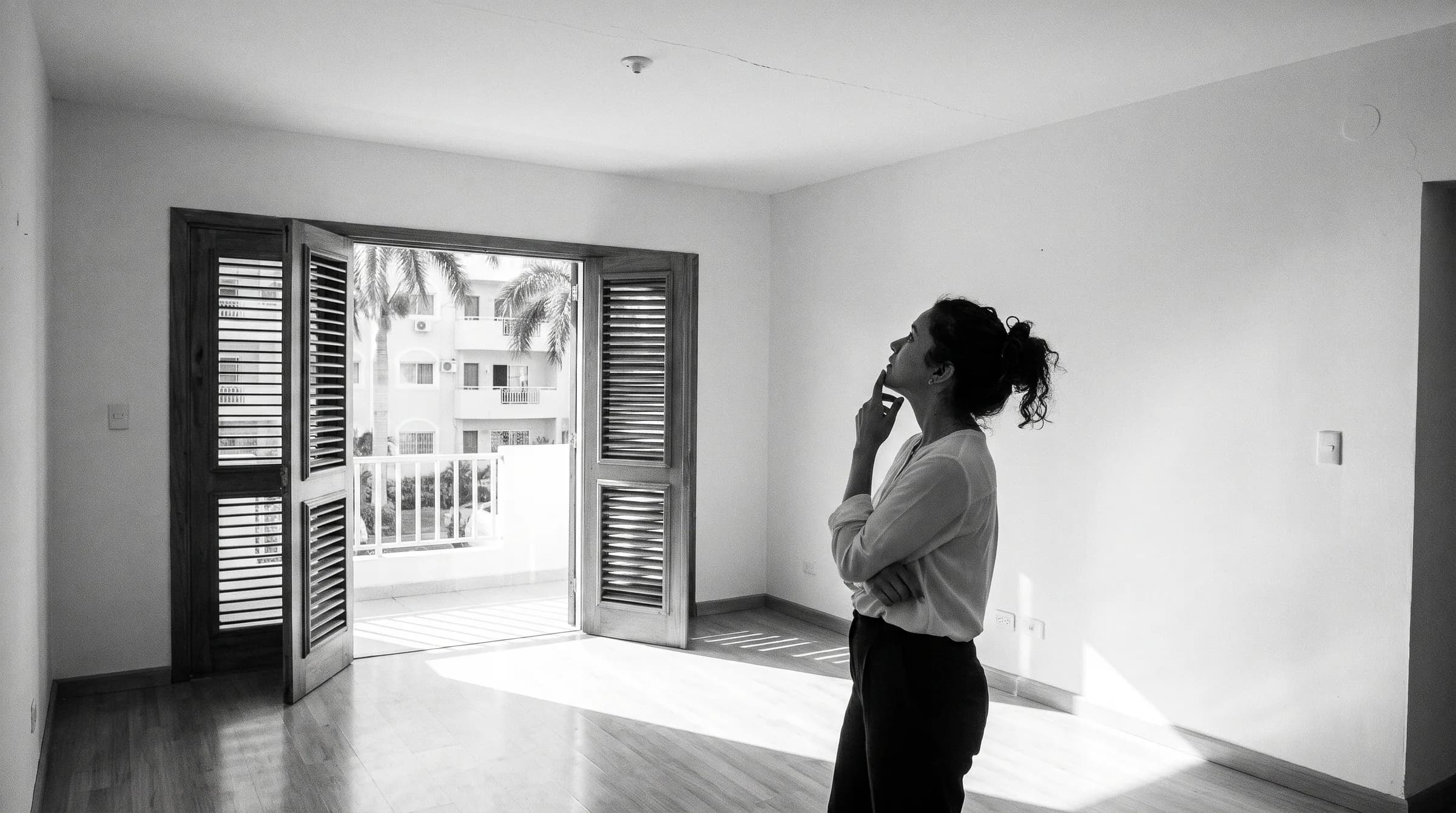
Many people start looking at apartments based on photos, price, or location. It makes sense. But in the Dominican market, information is scattered across listings, messages, and loose conversations—which is why it's worth having a plan before you ring any unit's doorbell. An apartment buying checklist isn't a bureaucratic chore: it's a way to decide calmly.
This article walks you through that order. We'll see what to define first, what to check during a visit, what services and costs to examine, what documents to ask for, and how to think about potential renovations. It's not here to push you into anything. It's here so you know what to ask and when.
The common belief: "the first thing is to find the apartment"
The most widespread idea is that the process starts when a property you like appears. In practice, it starts earlier: with the decision of where to search and who you'll search with. That starting point shapes the quality of information you'll receive later, how the steps will be explained to you, and the pace at which you'll be asked to decide.
Toca Timbre
Verified properties, certified agents. You just decide.
If the search starts with a listing without context, it's easy for the conversation to revolve around price and availability. If it starts with a verifiable agent who explains the process, delivers information in writing, and lets you compare options, the order shifts: first you understand, then you choose.
None of this is a buyer's mistake. It's the result of a market where everyone runs their own method and no common route exists that someone explains to you from the start.
Context: a market with scattered information
 In the Dominican Republic, formal projects, private sales, and agents with different levels of training coexist—and documentation isn't always presented the same way. Associations like the AEI note that their certified agents must meet integrity standards and offer guidance on purchases, sales, and rentals. That helps organize the process, but it doesn't replace independent review by a lawyer, engineer, or architect.
Add to that the fact that construction and prices change frequently, and that the costs tied to a purchase (taxes, legal fees, closing) don't always show up in the listing. That's why order matters more than speed.
An apartment buying checklist, in five stages
1. Define your starting point. Before visiting anything, clarify your total budget, not just the price. Include your payment method, down payment, legal fees, taxes, professional fees, maintenance, insurance, and a repair fund. Also nail down location, size, bedrooms, parking, elevator, security, noise tolerance, and your ideal move-in date.
2. Inspect with a technical eye. Check:
- Cracks, moisture, leaks, peeling paint, and bad smells.
- Uneven floors, doors, and windows.
- Water pressure, drainage, water heater, and bathrooms.
- Kitchen, air conditioning, electrical panels, and outlets.
- In buildings: facade, roof, parking areas, cistern, pumps, backup generator, elevators, and fire safety systems.
Ask when repairs were done and who did them. A visual inspection alone doesn't confirm structural safety; if you see cracks, layout changes, or signs of moisture, ask an independent professional to check it out.
3. Verify services and recurring costs. Confirm who supplies electricity and water, how stable the service is, the cistern capacity, whether the backup generator works, and the maintenance fee. Ask for payment receipts and whether the apartment or the building has any debts. Also find out about flood risk in the area.
4. Review the paperwork before you hand over a deposit. Request the Title Certificate or equivalent document, the seller's ID and authorization, the floor plan or survey, the building rules (if it's a condo), and a certificate of no liens or encumbrances. Names, square footage, property number, and location must match across all documents. A real estate lawyer should verify ownership, liens, seizures, inheritances, taxes, and contract terms.
5. Evaluate renovation without assuming everything is allowed. Painting, changing lighting or cabinets is usually straightforward. Touching walls, the facade, balconies, pipes, electrical work, or structure is a different conversation—and it may need condo approval and building permits.
A moment many buyers recognize
Imagine Carla, 34, in Santo Domingo. She's inside an apartment she likes. The light is good, the location works for her, and the agent with her is friendly. Then she notices a stain on a corner of the bathroom ceiling. She hesitates. If she asks about the stain or the documents, she worries she'll seem distrustful or "complicate" the sale.
That silence is very common, and it's not weakness. It's what happens when the process wasn't explained beforehand. An agent who responds calmly, admits what she doesn't know, and recommends independent verification turns that question into something normal, not uncomfortable.
Renovate or buy ready: the comparison that matters
Let's say, as an illustrative example with hypothetical numbers, that Carla compares two options. The first is an apartment listed at RD$5,800,000 that needs a new kitchen and bathrooms, with an estimated renovation cost of RD$700,000 and a 15% contingency (RD$105,000). The total comes to about RD$6,605,000. The second is a move-in-ready apartment at RD$6,600,000.
The RD$800,000 difference in the listed price almost vanishes once you add the work. And there are still factors the number doesn't capture: months of oversight, contractor coordination, possible delays, and the chance of finding hidden problems in electrical, plumbing, or water damage.
Renovating gives you freedom to adapt the space and, sometimes, a lower initial price. Buying ready usually costs more upfront, but it offers predictability and lets you move in quickly. The right choice depends on total cost, available time, stress tolerance, your ability to oversee work, and your life stage. If you're thinking of a major renovation, check permits and approvals before you buy, not after.
The process, in order
The practical rule is to move through the stages and skip nothing:
- Talk to a verifiable agent.
- Visit the apartment.
- Inspect with professional help if needed.
- Request and review documents.
- Compare total cost, including possible work.
- Only then, negotiate.
Don't hand over money based solely on a conversation, a listing, or a verbal promise.
Final reflection
A checklist doesn't remove uncertainty, but it breaks it into small pieces you can review one by one. Buying an apartment rarely gets decided in one visit; it gets decided in the order you ask the questions. And a process where you can ask without feeling pressure is, by itself, already a good sign.
Frequently asked questions
What should I check before buying an apartment in the Dominican Republic?
It's worth reviewing five areas: your total budget, the physical condition of the apartment and building, services and recurring fees, legal documentation, and renovation possibilities. Doing it in that order keeps you from making snap decisions.
Minimum documentation usually includes the Title Certificate, floor plan or survey, certificate of no liens or encumbrances, and, if it's a condo, its rules. A real estate lawyer should verify it.
Is it better to buy an apartment to renovate or one that's move-in ready?
There's no single answer. Renovating offers design freedom and sometimes a lower initial price, but it means variable budgets, time, and supervision. Buying ready costs more up front, though it's usually more predictable.
What helps is comparing total cost, not the listed price, and being honest about the time and energy you have for a project.
When is it safe to hand over a deposit?
Ideally, after reviewing the basic documentation and a lawyer confirms ownership and the absence of liens. A conversation, a listing, or a verbal promise isn't enough.
If they ask you to decide before you can review something, it's reasonable to ask for time and request the missing information in writing.
To start with more clarity
If you're at the exploration stage, Toca Timbre is an app where buyers can see properties posted by agents and contact them directly on WhatsApp. It's a place to start looking at the market with more order, at your own pace, and before any first contact. If you'd like to check it out, you can do so here: Toca Timbre.
Sources
- Association of Real Estate Agents and Companies (AEI) — https://aei.com.do/
- Real Estate Registry, Technical Provision on Requirements for Registry Actions (DNRT-DT-2025-003) — https://ri.gob.do/wp-content/uploads/2025/12/Disposicio%CC%81n_Te%CC%81cnica_sobre_Requisitos_para_Actuaciones_Registrales_-_DNRT-DT-2025-003.pdf
- MIVHED, License and permits for low-cost housing projects — https://mivhed.gob.do/proyectos-de-vivienda-de-bajo-costo/licencia-y-permisos-de-construccion-para-proyectos-de-vivienda-de-bajo-costo/
- MIVHED, Construction license and associated permits — https://mivhed.gob.do/permisos-y-licencias-de-construccion/licencia-de-construccion-y-permisos-asociados/
- DGII, Fiduciary and Real Estate — https://dgii.gov.do/servicios/Catlogos%20completos/FideicomisoeInmuebles.pdf
- Alburquerque, Guide to buying real estate in the Dominican Republic — https://www.alburquerque.com.do/guia-para-comprar-un-inmueble-en-la-republica-dominicana/
- Instadigs, Closing costs in the Dominican Republic — https://instadigs.com/es/blog/gastos-de-cierre-republica-dominicana